
What Is a Dzong?
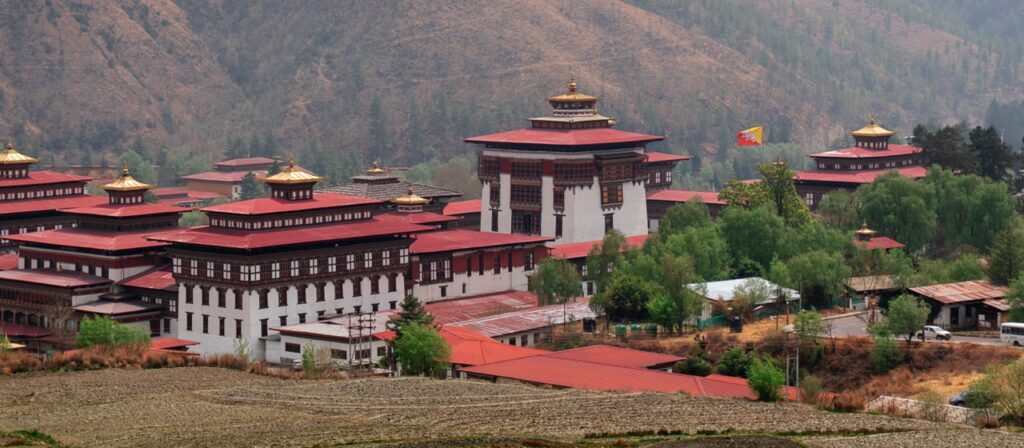
I didn't know what a dzong was until I started planning my trip to Bhutan, but you really don't understand what one is until you're standing in front of it. It's probably one of the most spectacular man-made buildings I've ever come across — perhaps because I couldn't imagine its scale, its colourful interior, or its hand-worked materials crafted down to the last detail.
Bhutan's dzongs are fortress-monasteries whose current function is twofold: religious and administrative. Monks live inside the dzong, and government officials go there to work every day, sharing the courtyard and common areas.
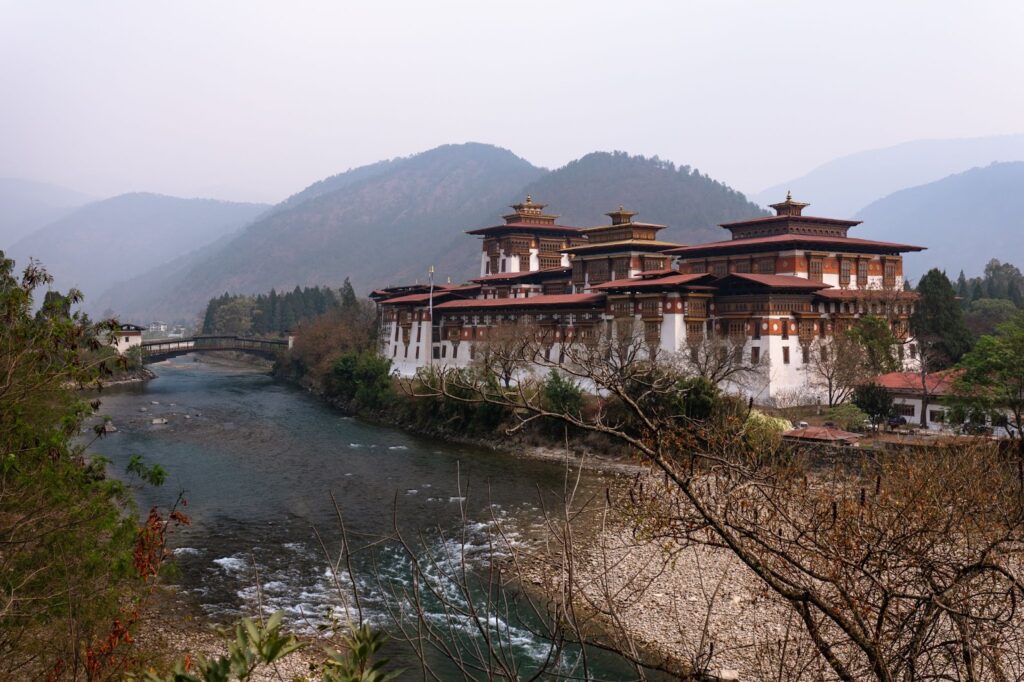
They are traditionally built from stone and wood, without cement or nails, fitted together dry using centuries-old techniques that achieve this impressive structure. They tend to be strategically located — historically for defensive and even symbolic reasons — among hills, in the middle of a valley, or at the confluence of two rivers, as is the case with Punakha dzong, which I was lucky enough to visit.
Punakha Dzong: History and Symbolism
I remember the day we went to see it. It dawned sunny, with a blue sky that revealed the snow-capped mountains on the other side of the valley. We went with our driver and our guide, who always used the drive to tell us the history of the monastery or temple we were heading to. That way, he'd later let us enjoy many of the monastery's rooms in silence, wandering around and taking photos.
He told us that Punakha dzong is one of the most impressive, thanks to its location between two sacred rivers, the Mo and the Pho, and for being one of the largest. It dates back to 1637, making it the second dzong built in Bhutan, and it served as the seat of government until the mid-1950s. It is the place where every king of Bhutan has been crowned to date, including the current one in 2006, the fifth king the dragon kingdom has had so far.
Although it has been restored several times due to fires, earthquakes and even a glacial lake outburst flood, the restoration techniques used today are still the traditional ones. Pieces perfectly fitted together without nails or cement. A true masterpiece.
The Main Courtyard and the Bodhi Tree
As soon as we parked, we crossed a wooden suspension bridge that leads to the dzong's main courtyard. Once you go through the gate, all you can hear inside the courtyard are birds, the faint murmur of monks if it coincides with the end of some ceremony, the click of the odd camera shutter, and, with luck, some stray rooster crowing at hours that don't suit him. On this occasion, we also saw a couple of cows crossing the wooden bridge, looking for some grass to graze on.
In that first courtyard there was a huge white chorten and a bodhi tree — a kind of giant fig — right in the centre. It's a sacred tree in Buddhism, because it was under one of these trees that Siddhartha Gautama attained enlightenment and became the Buddha, around 2,500 years ago in India. Sitting in the shade of that tree, gazing up at the scale of the fortress walls, with nothing but the sound of the wind stirring the leaves and birds fluttering among its branches, made me feel so happy and so calm that it's hard to put into words.
The Inner Temple and the Life of the Monks
To reach the second courtyard, you skirt around the main tower, or utse, six storeys high and topped with a golden roof with dragons at its corners. This is where the monks sleep, and it also houses the classrooms where they study philosophy and Buddhist practices. We arrived at the second courtyard just as class was letting out, so the parade of red robes and Crocs (yes, the monks wear Crocs) was one of a kind.
We took off our shoes to enter the main temple; as in every temple, the no-photography rule was more than clearly signposted. Inside, absolutely every wall was decorated with images of the Buddha, accompanied by gold statues, hand-woven murals, and carved wood painted in black, gold and red tones. The ultimate expression of tantric Buddhism, all concentrated in one hall with wooden tables where the monks meditated, seated on huge, colourful rugs, surrounded by a handful of tourists staring open-mouthed at such a beauty of colour and sound.
We left the temple, put our shoes back on, and went to have momos and beer for dinner, while we talked with Dendup, our guide, about how lucky we'd been to get into that ‘chapel’ — the only one open to tourists inside Punakha dzong.
Why Visit a Dzong on Your Trip to Bhutan?
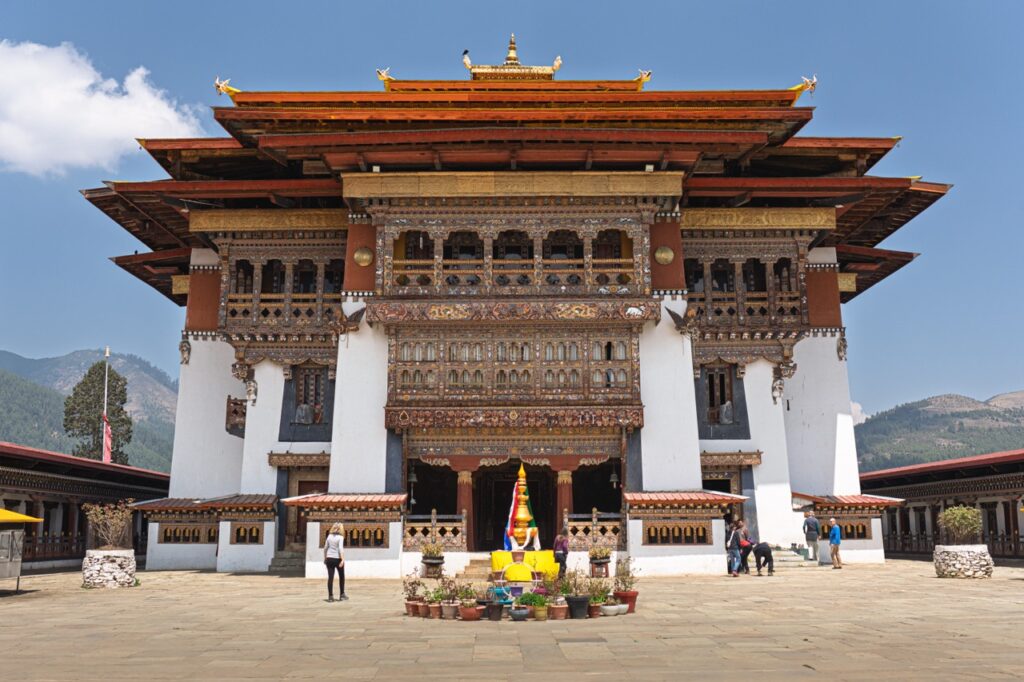
Without a doubt, visiting a dzong should be a must on any trip through Bhutan. They aren't just functional buildings, but also a symbol of balance between land, spirit and community. Their scale really is imposing, inside and out, and they give off a sense of harmony the moment you step through their gates — one you have to experience to understand.
Feeling inspired yet?