
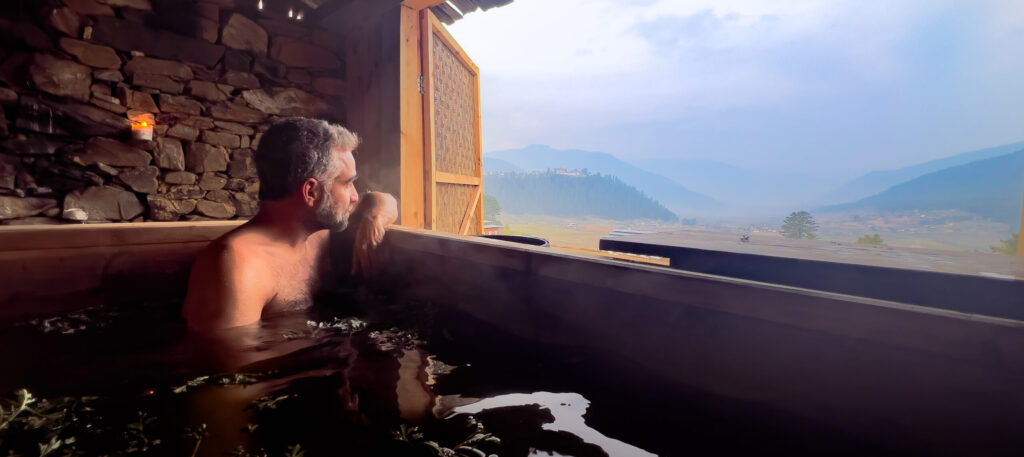
In the middle of a silent valley, surrounded by farmland and small houses scattered in the distance, with the majestic Himalayas as a backdrop, I experienced one of Bhutan's most ancestral and special traditions, passed down for centuries from generation to generation.
The Dotsho is an experience deeply rooted in Bhutanese tradition and wellbeing. It is a traditional hot stone bath, used for centuries by the Bhutanese for both therapeutic and spiritual purposes.
The origins of the Dotsho
This tradition has evolved over the years, to the point that it can now be enjoyed at many farmhouses in Bhutan, mainly in the valleys of the western region. This hot stone bath has been a source of physical and spiritual healing for the Bhutanese for centuries. In the old days, families would go to the rivers to gather special stones, prepare wooden tubs with cold water straight from the riverbed, light a fire, and once the stones were red hot, plunge them into the water to heat it — that was the moment the family would climb in and enjoy a hot, relaxing, therapeutic bath. A form of rest, connection and healing. It was a weekend family tradition.
The Dotsho today
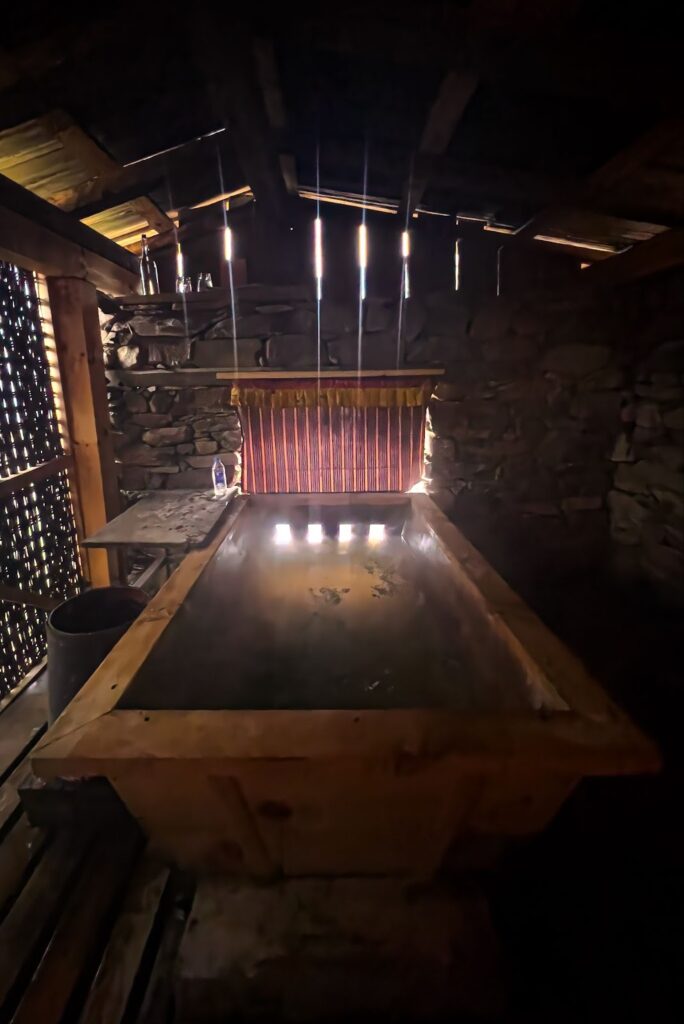
Nowadays, those same families have brought the Dotsho into their own homes. Craftsmen build beautiful wooden tubs, usually set up behind the houses, overlooking the valley. The stones are still gathered from the rivers and heated over an open fire, then placed into a separate compartment of the tub. On contact with the water, they release minerals and steam that heat the bath water until it reaches the desired temperature. Nowadays, local plants such as mugwort, wild mint, rhododendron or juniper are often added too, known for their healing properties — mixed with the hot water, after a few minutes in the tub our bodies absorb their vapours and benefit from these herbs' properties. These properties are analgesic, anti-inflammatory and relaxing, and, according to traditional Tibetan medicine, help restore the body's energetic balance.
My experience with the Dotsho
I remember arriving at the farmhouse after several hours of driving, and just as many hours of trekking, and after showing us our room, being asked: "What time would you like your bath?" Suddenly all the accumulated tiredness disappeared — I wanted to get straight into the tub and enjoy the famous hot stone bath.
We grabbed our flip-flops and towel and walked along a path that ran behind the house, until we reached a kind of cabin with wide wooden doors that opened to the sides — and suddenly, inside, there was the tub, steaming, with an intense scent of flowers and mint. They explained how to call for more hot stones once the water started to cool: someone would be waiting outside for us to call out DO!, which means "stone" in Dzongkha. At that signal, the man would take one of the stones from the fire and drop it into the tub, heating the water back up. They gave us two bottles of water and closed the doors, waiting for us to let them know once we were inside the tub, submerged in that hot water that seemed to loosen a knotted muscle every 10 seconds.
When we were ready we called out, and they opened the wooden doors again, and suddenly I could see the valley, the crops, the birds, and the steam rising from every pore of my skin toward the horizon — and I thought it wouldn't matter doing another day of trekking tomorrow, as long as I could have a hot stone bath again before bed. The image of the valley slowly appearing as they opened the doors of that little cabin while we were already in the tub is something I will never forget. Another one of my mental postcards, kept for the memory. After several DO!s and nearly an hour submerged in the tub, we said goodbye to that wonderful DOTSHO.
The Dotsho heals both body and mind. You go looking for relaxation and healing, but at the same time you gain a deep connection with Bhutan's rich heritage — and that is something they do very well there: preserving their cultural and spiritual heritage over the years, and having the generosity to share it with us.
If you go to Bhutan, you shouldn't miss it. It's one of the most authentic experiences you will never forget.