
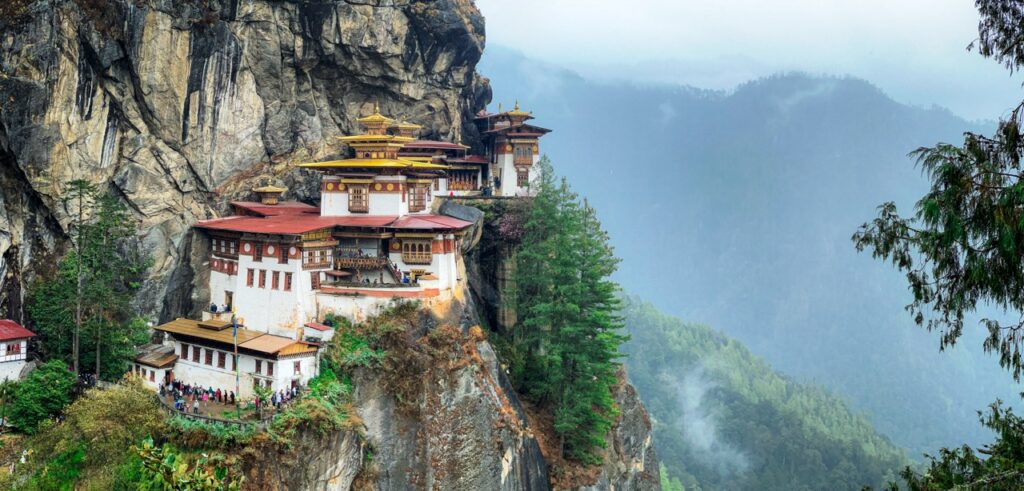
Before I even set off on my trip to Bhutan, I'd already had the Tiger's Nest Monastery (Tiger's Nest, or Taktshang) on my mind for years. That image, once you see it for the first time, is impossible to forget. I first discovered it in a travel magazine — the kind I used to devour every month when a new issue came out. I'd run down to the newsstand below my parents' house. The newsagent already knew me and had my copy ready; even if I was ever late picking it up because I happened to be on holiday, he'd keep it for me.
Many years after first seeing the monastery in photos, I finally made it to Bhutan. This excursion is a must for any traveller visiting the Dragon Kingdom. In fact, it's the trip everyone saves for last — the crown jewel, the one every traveller hopes to do at least once in their life. Anyone who has seen the Tiger's Nest Monastery in a documentary or on social media would add such a work of art to their list of places to see.
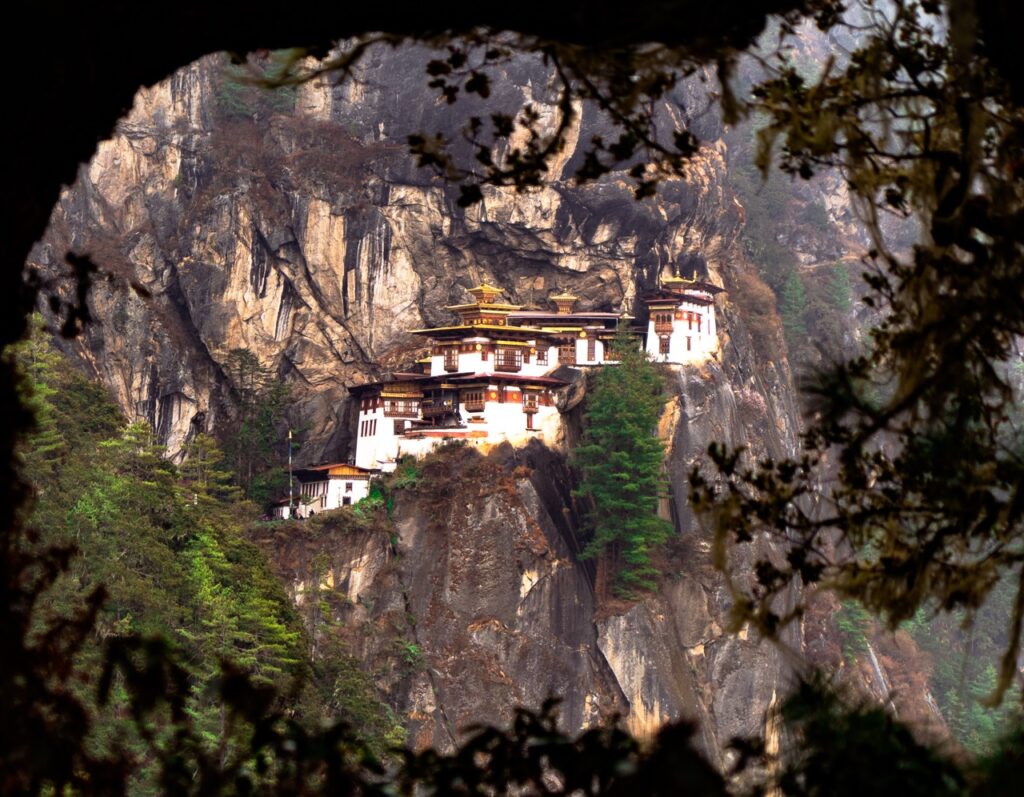
The curious thing about the monastery is that it's always the same image that appears. The monastery clinging to a rock face nearly 900 metres high, surrounded by the towering Himalayas, in the Paro valley. Why is it always that one photo? Because as soon as you arrive at the monastic complex, you're required to leave all your personal belongings in a locker — including phones, photo and video cameras, bags, backpacks, and anything else besides the clothes on your back.
In Bhutan, filming inside temples isn't allowed, and at the most famous one of all, the checks are even stricter. That's exactly why never seeing a single photo of the monastery's interior gives it such a magical air — one that makes you want, even more, to visit what should, in my opinion, be the eighth wonder of the world.
The legend of the monastery
The only way to reach the monastery is on foot — or on the back of a magical tiger, which is how Guru Rinpoche is said to have arrived. Tradition holds that he was carried on the back of a tigress — identified by some as Yeshe Tsogyal, one of his disciples transformed into a tigress — up to a sacred cave on the cliff. In the cave, known as Taktsang Senge Samdup, or "Lion's Cave", Guru Rinpoche meditated for three years, three months, three weeks, three days and three hours, with the aim of subduing local demons and blessing the Paro valley. From then on, the site was sanctified, and the tantric Buddhism he introduced spread throughout the country.
Although devotion and pilgrimage to the site date back to the 8th century, the monastery itself was formally built in 1692, on the initiative of Bhutan's fourth temporal ruler, Gyalse Tenzin Rabgye.
A blessed shaman monk
After an incredible week exploring Bhutan, all that was left was to head to Paro for the hike the following day. I was thrilled to finally see the inside of that monastery — another travel dream about to come true. But things don't always go the way you plan, and a bad step the afternoon before the trek left my travel companion unable to walk. After several hours of rest, ice and every anti-inflammatory we could find, we debated whether to skip it altogether, go on my own, or take the boldest option — the one that, in the end, turned out best.
A shaman monk knocked on the door of our hotel room and, with nothing more than a small pot of tiger balm and his thick fingers, worked a small miracle. Despite the pain of the massage and draining the swelling on the ankle, the tears were worth it. The next day, Ramón could walk again, almost without pain and very carefully. With a good bandage and a tightly laced boot, we set off on the trek of our lives — at a different pace, but far more excited, simply because just 24 hours earlier we'd thought we wouldn't be able to do it together at all.
What's inside the Tiger's Nest Monastery?
The day dawned sunny, but the monastery sits at over 3,000 metres, so we layered up and began the climb. Soaked by an unexpected storm, we reached the first viewpoint after two hours, a short break and a few crackers. Two hundred photos and almost three more hours of walking later, we finally reached the temple entrance.
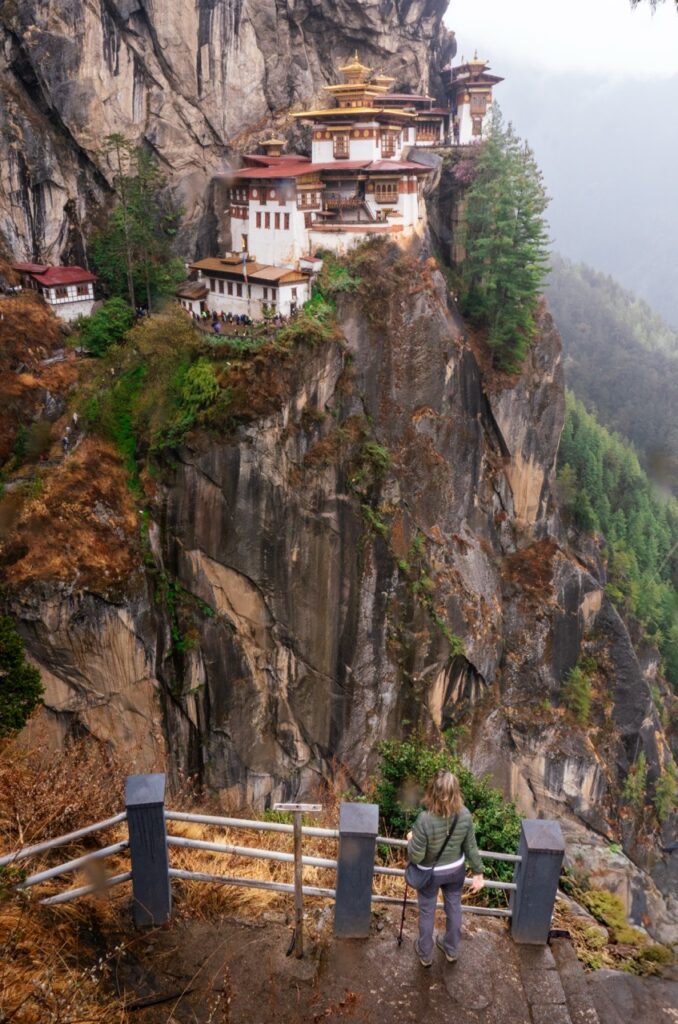
We left all our belongings in the locker and began exploring its eight temples inside. The imagery within was simply overwhelming — those colours, those depictions of Guru Rinpoche and tantric Buddhism. I enjoyed it twice as much because not knowing what's inside the monastery beforehand makes the surprise unmatched. We spent hours wandering the complex, climbing up and down stairs and reaching its strangest corners. I listened to our guide's explanations the way a little girl listens to her father telling her a bedtime story.
Finally we began the descent, slow and careful, because the rain didn't let up for the next four hours, and there was an ankle that needed more care than usual.
We arrived back at the hotel soaked, but happy. I hadn't expected that trek to come with rain, clouds that barely let us see the monastery from some of the viewpoints, pain from an almost-broken ankle, and the exhaustion of taking more breaks than usual on slippery, muddy ground. But now, every time I see a photo of the monastery in a magazine — sunny, under a perfect blue sky — I think about how my own photos and videos from that day, soaked and windswept but happy, are worth more than any perfectly retouched picture. Because I was there, we made it despite everything working against us, and that's something I will never forget.
The Tiger's Nest Monastery represents the convergence of myth, heroic architecture and profound spirituality — a temple born from a legend, built into living rock, that survived fire and still today lights the way for devotees and visitors alike. Personally, that day I believed in shamans. At least in one, who took the trouble to come and help us on a Friday night so we could fulfil one of our travel dreams. Thank you, or rather Kadinchey la, as they'd say there. We will never forget it, we will never forget you.