

When I started planning my trip to Bhutan, I read everything I could find online, and every post and article said the same thing: the Paro International Airport is one of the most dangerous in the world. Barely thirty pilots hold a license to land there, since a special permit is required because of how hazardous the approach is.
Why is landing in Paro so dangerous?
A small valley surrounded by mountains up to 5,000 metres high makes the landing manoeuvre especially delicate. With the plane's wings brushing close past the mountains as it descends, this airport challenges pilots with its short runway — barely two thousand metres long — and its fully manual landing, as Joan Servera, currently the only Spanish pilot licensed to land in Paro, explained to me. Flights only happen during the day, generally early in the morning, and only in optimal visibility conditions, since the pilot's skill and intuition are essential. The turns are made manually, using a temple, a forest or a row of houses as visual reference points.
It may be one of the most dangerous, but it's also one of the most beautiful I've seen, and landing on that small runway hidden in the Paro valley — which only comes into view when the plane makes its final turn before touching down — is a unique experience that adds even more meaning to the start of the trip.
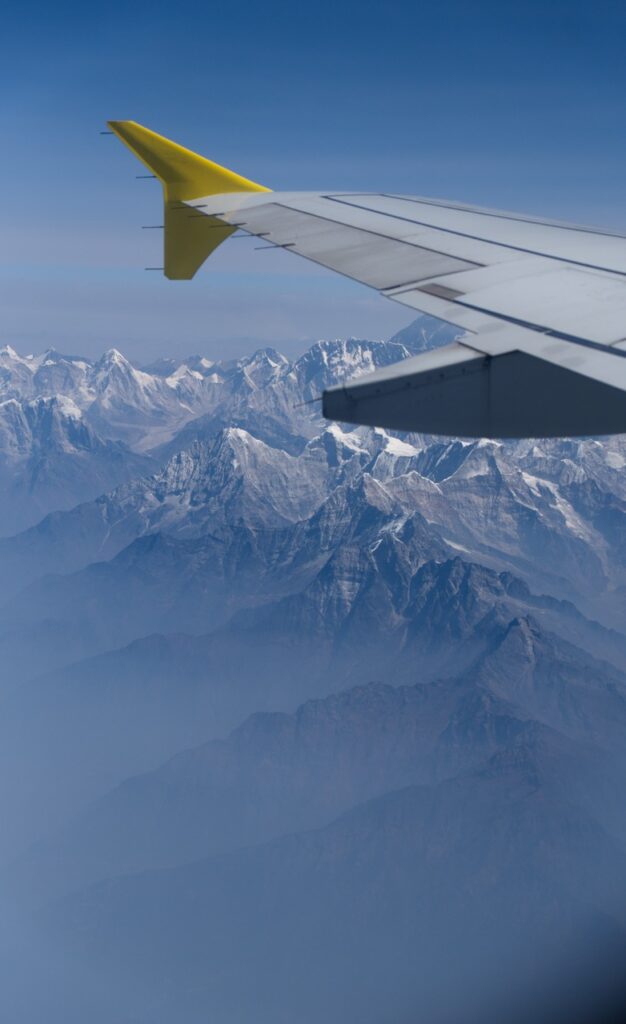
I was lucky enough to meet one of the pilots working for one of the two airlines that operate at that airport, DrukAir. While flying over the Himalayas, we were allowed into the cockpit to see Mount Everest through the pilot's eyes, surrounded by silent white peaks rising above the clouds. It was an incredibly moving few minutes, because I'd seen Everest in countless photos, but never from that perspective. It felt as though it had been waiting for us to step into the cockpit, gliding past in slow motion on the left side of the plane's window.
After a few photos and plenty of hugs for the crew, who stepped out of the cockpit to make room for us, we went back to our seats and buckled up. "We will shortly begin our descent," the pilot said in English, after having already announced it in dzongkha, Bhutan's official language.
Once we'd buckled our seatbelts, on the left side of the plane — the good side for seeing Everest partway through the flight — we waited impatiently for the descent. I was eager to discover this famous, feared airport. You don't see a runway in the distance like at other airports, because Paro's isn't visible until the very last moment, the very last turn. You're flying just a few hundred metres above houses, temples and hills. When the plane starts to lose altitude, it doesn't do so in a straight line — it weaves between peaks thousands of metres high. The cabin tilts to one side, then the other. This isn't turbulence; these are intentional manoeuvres.
Just before landing, the plane makes a sharp turn of almost 45° to the left to line up with the runway. This turn happens at very low altitude, and through the window you can see rooftops almost within reach.
Inside the plane it's silent, apart from the odd camera shutter, people with their phones trying to film the impossible, and murmurs of amazement as the runway finally comes into view. It's the final stretch — there's only one shot at it, in just a few hundred metres. The plane brakes, and you hear sighs, laughter and the occasional round of applause, well deserved this time. Minutes later you step off the plane into a landscape from another world: white mountains, pure air, traditional architecture and prayer flags fluttering in the breeze. And you think: Yes, it was worth it.
Afraid of flying, or afraid of not flying?
When people ask if I'm not afraid of flying, I always give the same answer: I'm afraid of not flying. Flying is travelling, flying is freedom, and flying into Paro airport, despite the difficulty of landing among the mountains, is a unique experience. I can't think of a better way to start a trip than landing among mountains, in a valley surrounded by little wooden houses with green, red and yellow roofs, where you're welcomed with ceremonial scarves, or Khata, and their warmest smiles.
The fear of never flying again — that's my only fear.